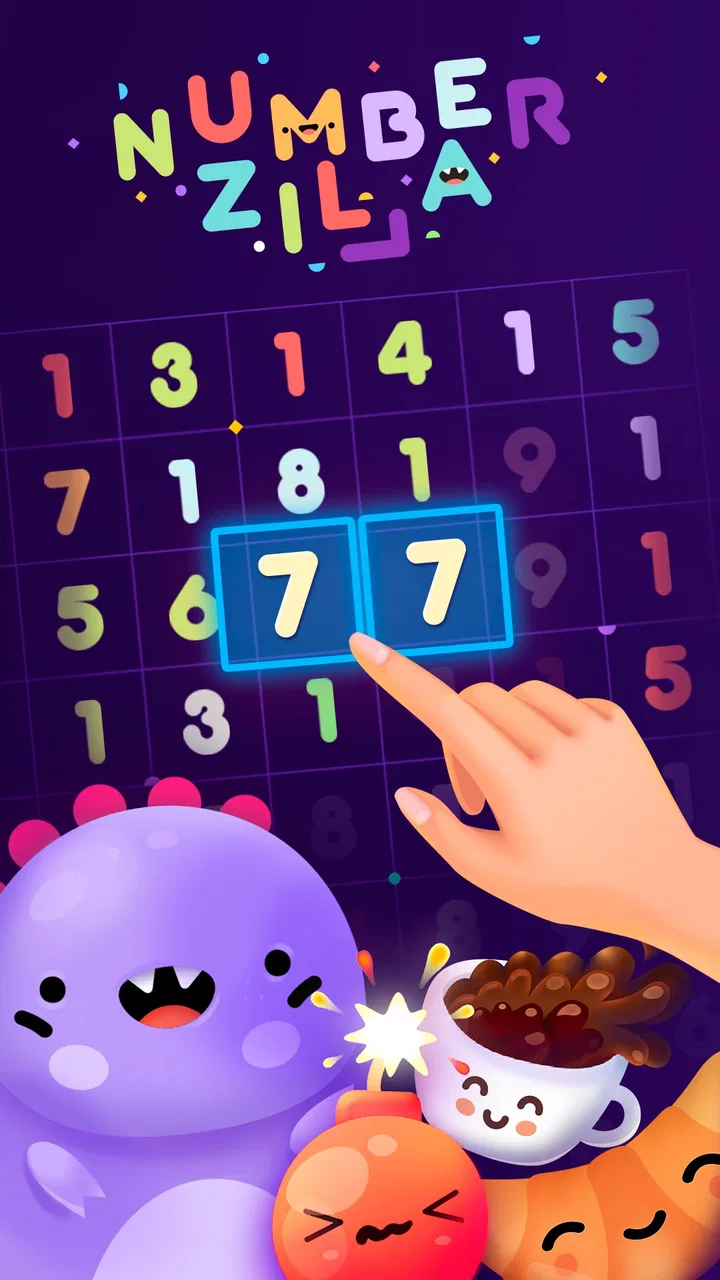
Numberzilla: Number Match Game
- 4.3
- Rating
- 10.00M
- Installs
- Free
- Price

 Analysis by App-foxy
I approached Numberzilla: Number Match Game expecting a simple way to pass a few spare minutes, but I found a puzzle that depends much more on attention than its friendly presentation first suggests. The basic idea is easy to understand: match numbers according to the game’s logic and gradually clear the board. What makes it engaging is the constant need to decide whether a move is useful now or whether it will leave the remaining layout awkward later.
That makes it a comfortable fit for short sessions, although I also found myself staying longer when a board offered a promising chain of decisions. It is a free board game from Appsyoulove, rated for Everyone, and it runs on Android devices using version 8.0 or later. Its broad audience makes sense: there is no complicated story to learn, no demanding reflex test, and no need to understand a large rulebook before beginning.
My first impression: approachable, but not mindless
The opening experience is deliberately gentle. Number tiles and a clean board communicate the central task quickly, so I did not need a tutorial-heavy introduction before making my first choices. That simplicity is one of the strongest parts of the design. I can open it while waiting for an appointment, understand the current position almost immediately, and start thinking without preparing for a long competitive match.
You May Also Like

 Blood Strike: 2.5 Anniversary
Blood Strike’s Loadouts Turn Every Drop Into a Tactical Gamble
A close look at Blood Strike’s custom loadouts: how fast access to signature weapons reshapes its battle royale rhythm, rewards preparation, and narrows the gap between fights.

 Pandora - Music & Podcasts
Pandora’s Music Is Easy to Start, but Harder to Recover
Pandora’s strength is its low-effort path from a seed to a station. Its weak spot is how much confidence it asks you to place in connection, setup, and quiet recovery.

 8 Ball Pool
 Is Built on Rivalries, Rematches, and Routine
A close look at the rivalries, rematches, shared routines, and unanswered safety questions that turn a quick pool match into a persistent mobile community.

 Samsung Music
’s Quiet Strength Is Playing What You Already Own
Its reach comes less from spectacle than from dependable access to a personal library. That simplicity is both the app’s strongest retention engine and its ceiling.

 AccuWeather: Weather Radar
AccuWeather Review: A Quick, Clear Forecast for Everyday Decisions
For everyday plans, the best forecast is the one you can understand quickly. AccuWeather makes rain timing, radar, and local conditions easy to act on, with a few trade-offs.

 Hill Climb Racing
Why Hill Climb Racing Still Turns Crashes Into One More Run
A tiny car, a bumpy hill and one more upgrade: Hill Climb Racing keeps resurfacing because its simple chaos makes every near-miss feel personal.
More From Our News Desk
View All News


At the same time, the game does not feel like a purely automatic matching exercise. A move can remove an obvious pair, yet the more important question is what that removal does to the rest of the board. I began looking for opportunities that would keep several options open instead of grabbing the first legal match I noticed. That small change in mindset gives the game more depth than its compact presentation suggests.
The scale of its audience reflects that accessibility. Numberzilla has passed 10 million installs and holds a 4.3 average from around 187 thousand ratings. Those figures do not replace personal experience, but they do fit what I felt during play: this is designed as a broadly approachable number puzzle rather than a niche brainteaser aimed only at expert players.
Because the game is free to download, it is easy to try without committing money first. The trade-off is that optional purchases range from $0.99 to $59.99 per item, so I would advise checking the purchase flow carefully if children use the device. The Everyone age rating makes the game suitable for a wide household audience, but an age rating does not remove the need for sensible control of spending.
A visual language built around clarity
The art direction works best when it stays out of the way. The board is the focus, and the numbers need to remain readable while I compare positions and search for legal relationships. I appreciated that the presentation supports concentration instead of covering the play area with decorative distractions. The result is a mood that feels calm and orderly, which suits a puzzle based on scanning and planning.
That visual restraint also helps the game feel less intimidating. Some number puzzles can look like spreadsheets, while others use so much decoration that the actual choices become difficult to read. Numberzilla sits closer to the approachable middle ground. Its visual identity makes the board feel like a casual place to think, not a test that is trying to make me nervous.
The setting is abstract rather than narrative. I was not playing through a character’s journey or exploring a detailed fictional location; the board itself is the environment. That is a sensible choice for this type of game because it puts the emphasis on the changing arrangement of numbers. The atmosphere comes from the rhythm of clearing space and discovering the next opportunity, not from plot or world-building.
One useful consequence of this approach is that the game works in different emotional situations. When I want a quiet distraction, the uncluttered board supports that. When I want to exercise my attention, the same board becomes a compact planning problem. It does not force a dramatic mood on me, which is valuable for a game intended to fit around everyday routines.
Why the presentation matters to the puzzle
In a number-matching game, visual hierarchy is part of the mechanics. If every tile competes equally for attention, the board becomes tiring to read. Here, I could generally focus on the numbers first and treat the surrounding presentation as guidance rather than noise. That made it easier to compare possible moves and notice when a seemingly attractive match might create an inconvenient leftover pattern.
I also found that the clean look encourages a slower style of play. There is less pressure to tap quickly just because the interface feels energetic. I could pause, inspect the arrangement, and make a decision based on the board rather than on impulse. For players who prefer rapid arcade action, that may feel restrained; for anyone who enjoys quiet logic, it is a strength.
The limitation is equally clear: players who need a strong theme, expressive characters, or a sense of place may find the setting too bare. Numberzilla’s atmosphere is functional and soothing, not richly imaginative. I would choose a story-led puzzle or a visually elaborate board game instead if the world around the mechanics is my main reason for playing.
Sound and the rhythm of a session
The game’s mood is shaped as much by pacing as by appearance. Each decision is small, but the repeated cycle of spotting, checking, and clearing creates a steady rhythm. I found that rhythm particularly suitable for short breaks because it gives me a sense of progress without requiring a fixed block of time.
Rather than feeling like a race, a typical session develops through observation. I might begin by removing a straightforward pair, then slow down when the remaining numbers become less obvious. That change in tempo is important: the game starts as a quick diversion and can gradually become a more deliberate concentration exercise.
The sound design supports that general feeling without becoming the main attraction. In my experience, the audio cues are best understood as feedback for actions and progress, not as a soundtrack I would play separately. They help give taps and successful clears a sense of completion, while the overall experience remains quiet enough for casual use.
This makes Numberzilla a reasonable companion for moments when I do not want a loud or emotionally demanding game. I can imagine playing it during a commute with the device’s sound reduced, or using it at home while listening to something else. The board remains understandable even when audio is not the center of attention, which is exactly what I want from a flexible puzzle.
The downside of this restrained rhythm is that it may not satisfy anyone looking for constant excitement. There are no reflex-heavy bursts to keep the pulse high, and the satisfaction comes from solving an arrangement rather than from spectacle. If I am in the mood for fast rounds, competitive pressure, or dramatic audiovisual rewards, this game feels deliberately too calm.
How the number matching fits the mood
The central mechanic and the presentation reinforce one another. Because the game asks me to inspect relationships between numbers, a calm board and measured pacing give the thinking room to happen. The atmosphere would work less effectively if the interface pushed me to act before I had read the position. Instead, the visual and audio language encourage a patient loop: scan the board, identify a useful match, clear it, and reassess.
That loop is also why the game can feel surprisingly absorbing without a complicated ruleset. The challenge is not learning dozens of systems; it is improving the quality of each decision. I started noticing that a move should be judged by its effect on future choices, not only by the immediate satisfaction of removing tiles. This is one of the more interesting lessons hidden inside the casual presentation.
Mechanical fit: who will enjoy it and how to play more thoughtfully
Numberzilla is strongest for players who like logic games that can be paused mentally between moves. It suits someone who enjoys sorting possibilities, spotting patterns, and making gradual progress. It is also a good option for a household where different ages want the same basic game, since the premise is easy to explain and the Everyone rating reflects its broad accessibility.
I would not recommend it as the main choice for someone seeking a traditional board-game experience with opponents, negotiation, or a strong social layer. The enjoyment here comes from solving the board in front of me, not from reading another player or reacting to a changing opponent. Likewise, people who dislike numbers or find repeated visual scanning tiring may lose interest even though the rules are simple.
My most useful adjustment was to stop treating every available match as equally valuable. When several options appeared, I looked for the move that preserved the greatest number of future routes. Clearing a pair immediately can feel productive, but sometimes leaving it in place keeps the board flexible. This is a small strategic habit, yet it noticeably improved my decisions.
A second tip is to scan the whole board before tapping. The first match I notice is often not the best one, especially when the layout contains several possible relationships. Taking a few seconds to identify clusters and isolated numbers reduces the chance of creating a dead-looking section too early. This is where the calm presentation becomes mechanically useful: it gives me permission to think before acting.
I also recommend using the game as a reset activity rather than forcing a long session. If I play while tired, I begin making automatic choices and miss relationships that were visible a moment earlier. A short pause between boards or difficult positions helps me return with a clearer view. That makes the game more effective as a break than as something I would grind continuously for hours.
For everyday use, I found a simple scenario particularly convincing. If I have ten minutes before leaving home, I can start a board without worrying about finding another player or remembering a story. I make a few moves, stop when I need to go, and return later with the same kind of mental task waiting for me. It fills an awkward gap more gracefully than scrolling through unrelated content, while remaining lighter than a full strategy game.
The game’s free entry also changes how I evaluate it. I can test whether the number-based loop suits me before considering any optional purchase. My advice is to treat purchases as convenience choices rather than requirements for enjoying the basic idea. If the unhurried matching itself does not appeal during the first sessions, spending more will not solve that fundamental mismatch.
Compared with classic paper number puzzles, Numberzilla is more convenient because the board handles the clearing and lets me begin instantly. Compared with a traditional Sudoku-style game, it asks for a different kind of attention: I am reacting to relationships across a changing arrangement rather than filling a fixed grid according to rows, columns, and regions. Compared with fast match-three games, it is less about speed and visual cascades and more about choosing the right moment to remove something.
Those comparisons also show where alternatives may be better. I would pick Sudoku when I want a longer, more structured deduction problem. I would choose a competitive board game when I want interaction with another person. I would choose a match-three title when I want immediate audiovisual energy. Numberzilla occupies the quieter space between those options, offering number-based decisions without the formal structure of Sudoku or the urgency of arcade matching.
There is some friction in that middle ground. The basic action can become repetitive if I am not in the mood to examine small differences between possible moves. The abstract setting also means that a session’s emotional reward depends heavily on whether I personally enjoy the act of solving. Players who need frequent novelty may feel that the presentation changes less dramatically than the board itself.
The current version is 7.7.0.0, and the game’s long availability since its release on October 24, 2019, helps explain why it feels like an established casual puzzle rather than a brand-new experiment. I see that maturity as useful for someone who wants a familiar type of game that can be picked up quickly. It also means I would approach it with realistic expectations: the appeal is refinement of a straightforward loop, not a revolutionary new board-game format.
One question many people will have is whether it is suitable for children. The Everyone rating makes it broadly appropriate, and the rules are accessible, but I would still supervise younger players around optional purchases. Another likely concern is device compatibility: Android users need version 8.0 or newer, so checking the operating system before installing avoids an unnecessary surprise.
Players may also wonder whether the game demands constant internet attention or whether it is best for long sessions. I would not choose it on the assumption that every session must be lengthy. Its greatest practical strength is flexibility: I can approach a board for a brief mental break and stop when the moment ends. That short-session quality is more important to me than trying to turn it into an all-day game.
Finally, anyone deciding whether to keep it installed should ask what kind of satisfaction they want. If the pleasure of slowly improving a choice is appealing, the game has enough subtlety to remain interesting beyond the first explanation. If the goal is a rich story, deep social competition, or constant sensory stimulation, another board or puzzle game will probably be a better match.
My atmosphere verdict
Numberzilla succeeds because its art direction, sound, and pacing all protect the same central activity: looking carefully at a board and deciding what to do next. The presentation is not trying to overwhelm the numbers with personality. Instead, it creates a calm playable mood in which a small decision can feel meaningful, especially when I resist the urge to take the first obvious match.
I recommend it to anyone who wants a free, approachable number puzzle for short breaks, quiet concentration, or a low-pressure daily routine. I would skip it if I needed a narrative setting, multiplayer tension, or rapid action. For me, its best quality is the balance between instant accessibility and modest strategic depth. It looks simple when opened, but the most satisfying sessions come from learning to protect future options rather than merely clearing what is visible.
That makes the game easy to recommend with one qualification: try the basic loop honestly before spending anything. If the board’s measured rhythm feels rewarding, Numberzilla can become a dependable little thinking space. If the calm repetition feels flat, no amount of extra presentation will change what the game fundamentally asks you to do. Its strongest feature is the way a quiet interface turns ordinary number matching into a focused decision-making habit.
FAQs for Numberzilla: Number Match Game
01What is Numberzilla: Number Match Game?
Numberzilla is a casual number-puzzle game based on matching and removing pairs of numbers. The goal is generally to find identical numbers or pairs that add up to ten while clearing the board. Its simple rules make it easy to start, but later levels require careful planning, pattern recognition, and smart use of available moves rather than quick tapping alone.
02How do you play Numberzilla and what are the main rules?
To play, look for two matching numbers or two numbers whose total equals ten, then connect or select them according to the game’s allowed layout. Pairs may need to be adjacent or positioned with clear spaces between them, depending on the current board. When no useful pairs remain, players can usually add more numbers or use an available booster to continue.
03Is Numberzilla free to download and play?
Numberzilla can generally be downloaded and played without an upfront purchase, making it accessible to casual players. However, the free version may include advertising, optional in-app purchases, or paid features such as extra hints, boosters, ad removal, or additional resources. Before downloading, check the current Google Play or App Store listing for exact pricing and purchase details.
04Can Numberzilla be played offline?
Many of Numberzilla’s basic puzzle sessions can be played without a continuous internet connection, which is convenient for travel, commuting, or situations with limited data. Nevertheless, an internet connection may be required for advertisements, synchronization, updates, rewards, leaderboards, or in-app purchases. Offline availability can vary by device and version, so test the game after installation if this feature is important to you.
05Is Numberzilla suitable for children and does it collect personal data?
Numberzilla is easy to understand and may be suitable for older children who enjoy simple logic puzzles, although younger players may need help with advertisements or optional purchases. Parents should review the app’s age rating, privacy policy, and permission requests before installation. Data practices can change between versions, so consult the official store listing for current information about analytics, advertising, and personal data.
Pros
- Simple number-matching rules are easy to learn.
- Offline play makes it useful during travel or without Wi-Fi.
- Multiple modes provide variety beyond the classic puzzle.
- Helpful boosters can rescue difficult boards.
- Relaxing pace suits short
- casual gaming sessions.
Cons
- Frequent ads may interrupt gameplay
- especially after completing rounds.
- Some advanced hints and tools may require in-app purchases.
- Later levels can feel repetitive once familiar patterns emerge.
- Large boards may become difficult to read on smaller screens.
- Progression can feel slow without regularly watching ads.

Numberzilla: Number Match Game
Gallery